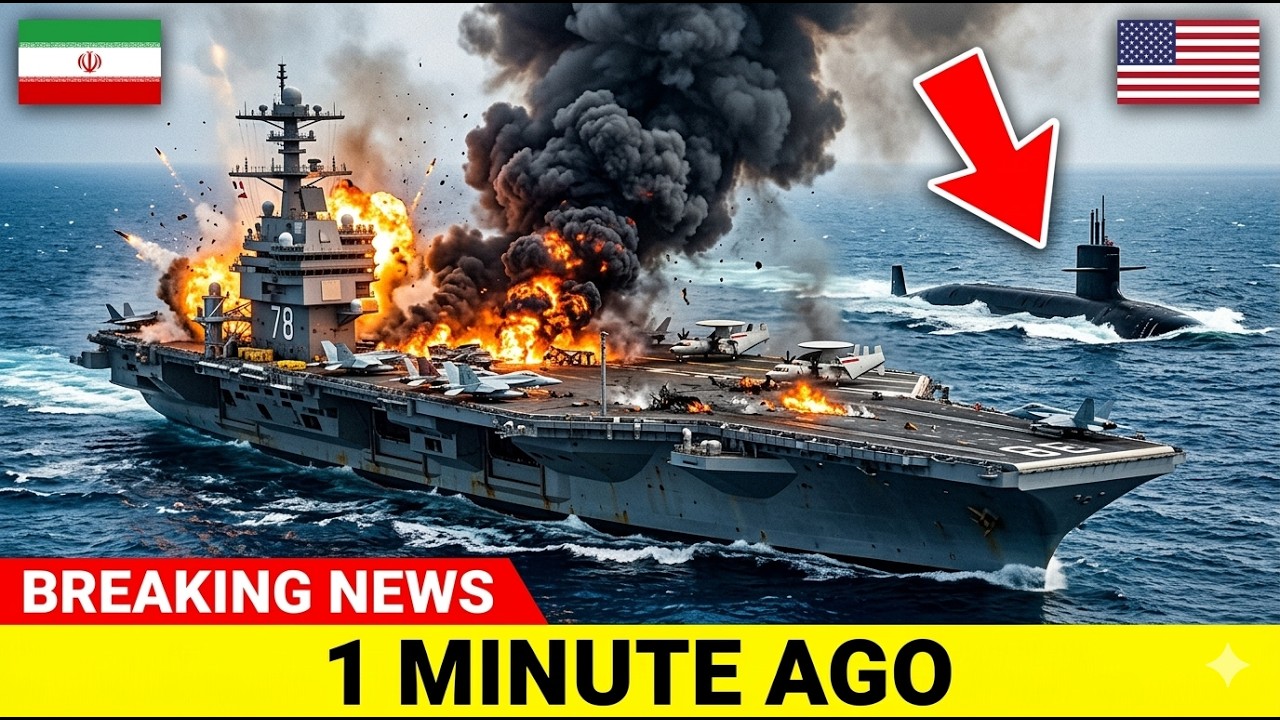
Three Iranian diesel-electric submarines, stealthy and lethal, slipped through the outer defensive ring of a U.S. Navy Carrier Strike Group.
In a coordinated ambush, they launched a spread of torpedoes directly at a 100,000-ton American aircraft carrier.
This incident raises critical questions about naval warfare and the vulnerabilities of even the most advanced military fleets.
In this article, we will dissect the events of that fateful morning and explore the implications of such an attack on global maritime security.
The Scene of the Incident
The Strait of Hormuz, a vital waterway for global oil transport, has always been a hotspot for military tension.
Its strategic importance cannot be overstated, as approximately one-fifth of the world’s oil supply passes through this narrow channel.
In recent years, the Iranian Navy has developed its submarine capabilities, particularly with the Ghadir and Fateh-class submarines, which are designed for asymmetric warfare.
These submarines are equipped with advanced stealth technology, allowing them to operate undetected in the busy waters of the Strait.
On that morning, the U.S. Carrier Strike Group was conducting routine operations, unaware of the impending threat.
The Detection: A Race Against Time
As the torpedoes were launched, the alarm sounded throughout the carrier.
Sonar technicians, trained to detect the faintest sounds in the ocean, sprang into action.
They worked quickly to isolate the “black hole” submarine signatures amidst the cacophony of ocean noise.
The detection of incoming threats is a critical skill in modern naval warfare, where seconds can mean the difference between life and death.
U.S. Navy sonar operators employ sophisticated algorithms and advanced sonar equipment to identify and track enemy submarines.
However, the challenge is immense; the ocean is a noisy environment, filled with the sounds of marine life, weather, and other vessels.
The technicians focused intently, knowing that the survival of the carrier and its crew depended on their ability to pinpoint the source of the attack.

Countermeasures: The High-Tech Response
Once the incoming torpedoes were detected, the U.S. Navy’s countermeasures were put into action.
The high-tech world of acoustic decoys came into play, designed to confuse and mislead enemy torpedoes.
These decoys emit sounds that mimic the carrier, drawing the torpedoes away from their intended target.
Additionally, the revolutionary Anti-Torpedo Interceptors were deployed.
These interceptors are designed to hunt the hunters, seeking out and destroying incoming torpedoes before they can reach the carrier.
The effectiveness of these countermeasures is a testament to the advancements in naval technology, but they are not foolproof.
As the crew worked frantically to implement these defenses, the tension onboard was palpable.

The Retaliation: A Show of Force
In the wake of the attack, the U.S. Navy was not going to sit idly by.
The MH-60R Seahawk helicopters, known for their versatility and speed, were dispatched to locate and neutralize the threat.
Armed with MK 54 lightweight torpedoes, these helicopters represent a formidable force in anti-submarine warfare.
Their ability to operate from the carrier and cover vast areas of ocean makes them a critical asset in any naval engagement.
As the helicopters took to the skies, they scanned the waters for any signs of the Iranian submarines.
The stakes were high; a successful counterattack could deter future aggressions and reaffirm U.S. naval dominance in the region.

The David vs. Goliath Scenario
The question remains: Is a Carrier Strike Group truly “unsinkable,” or is the asymmetric threat posed by Iran’s submarines a legitimate concern?
The situation presents a classic “David vs. Goliath” scenario, where smaller, less technologically advanced forces can challenge a superpower.
The Iranian submarines, while not as advanced as their American counterparts, leverage their stealth and numbers to create a significant threat.
This incident highlights the evolving nature of naval warfare, where traditional power dynamics are being challenged by innovative tactics and technologies.
The Tactical Breakdown of the Triangle Ambush
As we analyze the tactical breakdown of the “Triangle Ambush,” it becomes clear that this incident was not merely a random act of aggression.
The Iranian Navy has been honing its submarine warfare strategy, focusing on ambush tactics that exploit the vulnerabilities of larger fleets.
The use of three submarines in a coordinated attack demonstrates a level of planning and execution that should not be underestimated.
Each submarine plays a role in creating confusion and overwhelming the enemy’s defenses.
This strategic approach underscores the importance of adaptability and innovation in modern naval operations.

The Strait of Hormuz: A Flashpoint for Conflict
The Strait of Hormuz remains the world’s most dangerous naval flashpoint.
With tensions between the U.S. and Iran at a boiling point, incidents like this serve as a reminder of the precarious balance of power in the region.
The potential for miscalculation or escalation is ever-present, and the consequences could be dire.
As nations navigate the complexities of geopolitics, the lessons learned from this incident will shape future naval strategies and operations.
Conclusion: Reflecting on the Lessons Learned
In conclusion, the attack on the U.S. aircraft carrier by Iranian submarines serves as a stark reminder of the realities of modern naval warfare.
It challenges our assumptions about the invulnerability of advanced military technology and highlights the importance of preparedness and adaptability.
As we reflect on this incident, it is crucial to remember that the lessons learned extend beyond the battlefield.
They resonate with broader principles applicable to leadership, decision-making, and discipline under pressure.
The U.S. Navy’s commitment to operational excellence and lawful operations remains steadfast, even in the face of asymmetric threats.
As we move forward, the conversation must continue.
Do you think a swarm of midget submarines could actually take down a supercarrier?
Let us know your thoughts in the comments below.
This content is intended for educational and analytical purposes only, aiming to foster understanding and discussion around naval strategy and leadership values.
We credit all sources where possible and adhere to fair use and copyright guidelines.
Join us as we explore the complexities of maritime operations and the challenges that lie ahead.
